Imagine you have a solid trading strategy but can’t find anyone to back your trades. You know that prop trading firms provide traders with capital, but you can’t shake the feeling that they operate in a shady, underground world. You wonder, are prop trading firms legit? You want to reach your trading goals and develop your skills, but you also want to ensure you’re working with a safe, reputable firm. Understanding how to become a prop trader is an important step in navigating this space with confidence and clarity. This article will help you answer that question so you can move forward and engage with prop trading firms that offer safe, legitimate, and profitable opportunities for trading success.
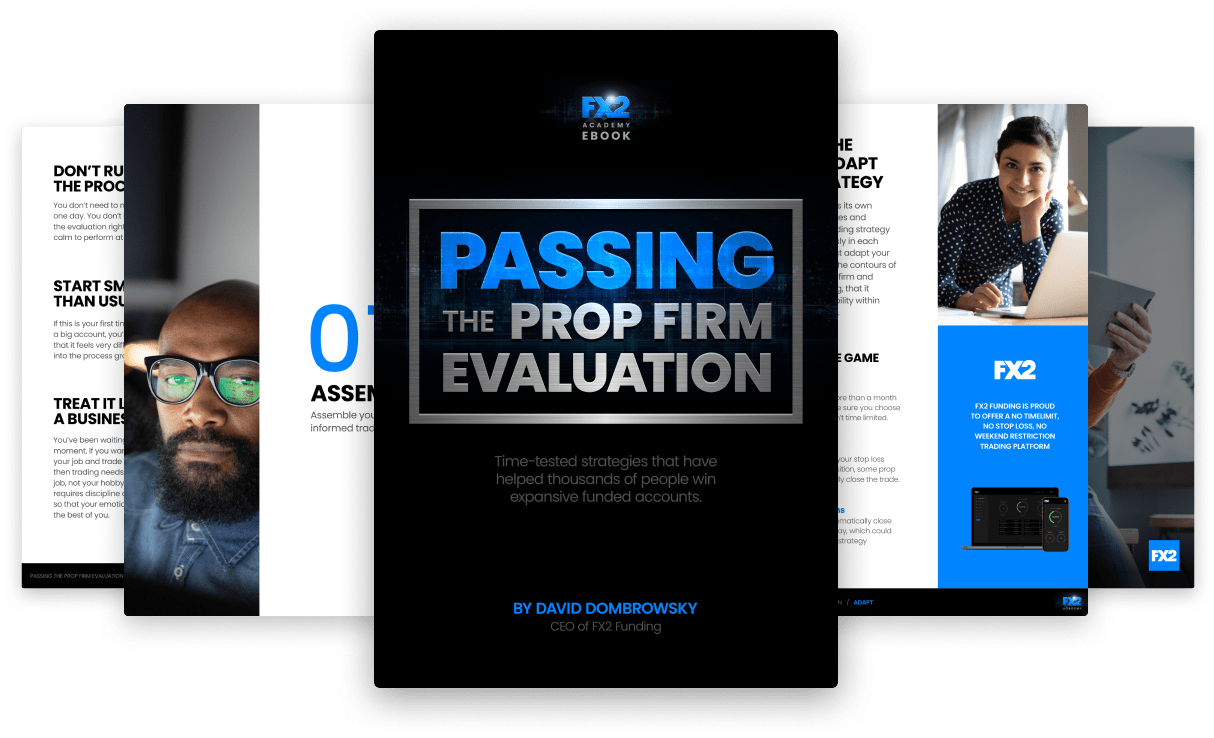
One great way to get started is with FX2 Funding. This prop trading firm helps traders develop their skills and achieve their objectives by providing a transparent and structured approach to prop trading.
Are Prop Trading Firms Legit?

The simple answer to the question, “Are prop firms legit?” is yes. There is nothing inherently scammy about prop firms’ business models. But how do they make money, then? For starters, prop firms do not give money to anyone who asks. They have a multi-stage evaluation process to ensure the traders they employ know what they are doing.
The evaluation process usually has strict requirements and limitations that traders have to adhere to pass. Those requirements and limitations can include:
- A profit target
- A drawdown limit
- A time limit
Evaluation Requirements
A trader may need to achieve a profit target of 10% of the account size in 30 days with a maximum drawdown of 10% of the account size. Such requirements ensure that only the most successful traders, who are unlikely to cause significant losses for the company, can get funds from the firm.
Prop firms also collect fees from their traders. It can be evaluation fees, fees for trading a live account for those who have passed the evaluation, or both. The fees often ensure that even a failed trader can be profitable for the prop firm.
Why Aren’t Prop Firms Regulated?
But if prop firms are legit, these questions arise:
- Why are prop firms not regulated? The vast majority of prop firms are not regulated.
- If they deal with money, why do they not have the same obligations as Forex brokers?
Prop firms deal with their own money, not someone else’s. This alone allows prop firms to avoid the lion’s share of regulations. On top of that, many prop firms do not give traders real money to manage. In these firms, even traders who have passed the evaluation and got access to a live account are still trading on a demo account with virtual capital.
Simulated Trading
Technically, no trading or other financial transactions are taking place. The firm may replicate successful trades of the funded traders on the firm’s real account. Those are trades made by the firm itself with its capital. Prop firms insist they are not financial institutions and do not provide financial services.
The most common way prop firms present what they offer is financial education. Some regulators find that questionable, and new legislation may demand that Forex prop firms be regulated similarly to Forex brokers in the future. For now, prop firms, for the most part, manage to avoid regulations and still stay within the bounds of the law.
The Dark Side of Proprietary Trading
The emerging proprietary trading space has come under significant market scrutiny recently, with the launch of fraud allegations and investigations by the US regulator into globally recognized prop firm My Forex Funds.
My Forex Funds has stopped all services, with all accounts and withdrawals being affected and suspended, including those being assessed or those that:
- Have passed the assessment
- Are waiting for a share of the profits
Global Participation
One hundred thirty-five thousand registered users across the globe who have paid at least $310 million are involved.
Regulatory Concerns
Some regulators believe that proprietary trading companies are controversial and do not rule out the possibility of introducing relevant regulatory legislation for Forex proprietary trading firms in the future. Most proprietary trading firms have successfully avoided regulation, making it easy to produce Ponzi schemes in this situation.
Many prop firms promote aggressive marketing strategies and induce investors to believe they can participate in the Forex market as professional traders with large amounts of money, causing the business to grow.
Investment Risks in Proprietary Trading
Take the proprietary trading firm Leveled Up Society, which promises to provide up to $200,000 in funding in two phases for traders who can meet the trading challenge. It also offers a profit share of up to 80-85%.
According to information from the Internet, as of August this year, the association had 76,403 members and spent $1.9 million, with an average per capita expenditure of $7,000. People can’t help but still worry about the safety of the money behind this.
Investment Risks
Prominent investment risks with proprietary firms Based on the above, taking the CFTC’s allegations against My Forex Funds, which employed fraudulent practices to solicit clients for leveraged trading, margin deposits, or financing for retail forex trading, along with cases of leveraged retail commodity trading, we analyze various risk factors associated with proprietary trading firms according to their features:
- Commit Fraud
- Conceal Actual Counterparty
According to the CFTC’s charges against My Forex Funds, the company claimed to provide clients with the opportunity to become professional traders, trading with third-party liquidity providers by:
- Using funds from Traders Global
- Sharing trading profits
Deceptive Practices
The company also assured clients that “your success is our business” and “we only make money when you profit.” Traders Global, instead of a third-party liquidity provider, acted as the counterparty for almost all client trades.
Traders Global executed orders from the most successful traders through STP accounts, where genuine overseas liquidity providers handle orders, while most orders were executed in a non-STP manner, allowing the platform to manipulate accounts.
Unlicensed Manipulation
It’s important to note that Traders Global does not hold a proper license. Its trading environment is subject to manual manipulation, which increases traders’ risk and makes it a classic Ponzi scheme.
Use Software to Diminish User Profits
One of the unethical practices employed by My Forex Funds involves the secret use of specialized software to manipulate client orders, executing them at prices lower or higher than what is displayed when the orders are placed. This results in customers incurring additional losses without their knowledge.
For more successful traders, as their profits increase, so does the size of slippage on their accounts, and order execution times will be longer to deter large withdrawals, ultimately:
- Cutting customers’ profits
- Increasing their losses
Unjust Commission Charges
My Forex Funds charges a trading commission fee of $3 per lot, which makes sense since it claims that Traders Global is a liquidity provider that warrants commission fees. These commissions are unnecessary because Traders Global is not a liquidity provider. It’s estimated that My Forex Funds profited approximately $7 million from commission fees.
Fabricate Reasons for Arbitrary Account Termination
My Forex Funds was accused of terminating customer accounts under pretenses, alleging customers violated platform trading rules. Customers did not breach any trading terms. My Forex Funds entirely adopted the consistent unethical practices of shady platforms, victimizing users.
Common Red Flags with Proprietary Firms
Not every prop firm is legit. Some firms design their business around evaluation fees rather than funding traders. Here are some warning signs:
- Unrealistic Promises: If a prop trading firm guarantees quick riches with a no-risk trading program, it’s a scam.
- No Real Payouts: A firm that delays or refuses withdrawals is a major red flag.
- Unfair Evaluation Rules: Some firms set impossible challenges, forcing traders to keep paying fees.
- Hidden Fees: Any proprietary trading firm that doesn’t promote a transparent fee structure should be avoided.
- Fake and Negative Reviews: Look beyond the company’s website and check independent trading forums for honest feedback.
While some prop firms use these shady tactics, many reputable prop firms offer real, live accounts and opportunities. Proper research and due diligence, carefully reading the finer print about challenges, and checking payout proof can help you:
- Avoid scams
- Find the right firm to trade with
Related Reading
- What Is Prop Firm Trading
- Is Prop Trading Worth It
- How to Get Into Prop Trading
- How Do Prop Firms Work
- How Do Prop Firms Make Money
- Prop Trading vs. Hedge Fund
How to Tell a Good Prop Firm From a Bad One?

It was earlier said that the answer to the question “Are prop firms legit?” was “yes,” but with the added qualification that while prop firms are not scams by their nature, this does not mean that there cannot still be plenty of scammers posing as prop firms.
There are many beginner traders among those attracted by prop firms, and such traders are especially tempting targets for scammers. How do you tell a good prop firm from a bad one? There are several considerations:
Ratings and Reviews: What Other Traders Are Saying
One of the first things to do when assessing a prospective prop trading firm is to look at ratings and reviews from other traders. You can find these on sites such as TrustPilot. You can also look for lists of good prop trading firms. Read what traders say about the firm.
Reviews can be manipulated, and some may be fake. Be suspicious if a review seems too positive, especially if you see several such reviews written quickly. Don’t listen to all negative reviews either. Traders can write negative reviews because they have failed due to:
- Not understanding how prop firms work
- What is required from traders who work with such firms
Reputation Matters
Because a firm is popular and well-known, it does not guarantee you will not have issues with it. A firm that took years to build up a good reputation is less likely one day to decide just to take all the clients’ money and run away than a firm that was created yesterday.
Website Quality: A Good Prop Firm Has a Professional-Looking Site
Go to the prop firm’s website. How good is it? A legit prop firm should have a well-designed site. If the firm’s site looks poor and has spelling mistakes, it’s likely a scam.
Requirements and Limitations: What Are They and Are They Fair?
You should consider:
- How strict the requirements are
- Limitations for the evaluation period
- Traders who have passed the evaluation
Either extreme is bad. If it is impossible (or almost impossible) to fulfill the requirements imposed by the prop firm, it’s a scam aimed at collecting fees for failed evaluation attempts.
Suspicious Requirements
If requirements are easy to meet, it is also suspicious. Legitimate prop firms want to protect themselves from losses and fund only the best of the best. Giving money to just anyone is an unsustainable business model.
If almost anyone can pass the firm’s evaluation, the firm most likely:
- Wants to collect money from as many traders as possible
- Does not intend to pay anything back
Unclear Rules
If requirements and limitations described on the site are unclear and confusing, it is also a worrying sign. A prop firm likely wants to use the lack of transparency to interpret the rules in a way that would allow it to close the trader’s account due to a perceived violation of the rules without paying anything back.
Customer Support: Poor Support Is a Red Flag
Legit prop firms that want their traders to succeed should have good customer service. Online trading is high-speed. Sometimes, minutes or seconds can mean the difference between:
- Profit
- Loss
Any trader issues should be resolved as quickly as possible. If a firm has bad or non-existent customer service, it is a scam. Even if it is not an outright scam, it is still a bad firm to trade with.
Related Reading
- Crypto Prop Trading
- Prop Trading Strategies
- Prop Desk Trading
- Best Prop Trading Firms for Beginners
- Highest Paying Prop Trading Firms
- Best Proprietary Trading Firms
- Best Prop Firms for US Traders
- Futures Prop Trading Firms
- Forex Prop Trading Firms
- Stock Prop Trading Firms
Get Funded and Start Prop Trading Today
FX2 Funding focuses on supporting traders, not their profits. We aren’t out to get you. We want to help you grow as a trader, and we do this by providing:
- Clear rules
- Fast payouts
- Supportive team of trading professionals
What more could you ask for?
What Makes FX2 Funding Different?
At FX2 Funding, we’ve built our proprietary trading firm on:
- Reliability
- Transparency
- Trader success
We stand apart in a crowded industry by delivering what matters most to serious traders:
- Consistently fast payouts
- Clear unchanging rules
- Responsive support from experienced trading professionals
Scaling Program
Our MT5 platform provides the professional environment traders need to succeed, while our scaling program enables growth from $25,000 to over $400,000 in funding as performance milestones are achieved.
We’ve designed our evaluation process to identify skilled traders and provide them with significant capital without requiring:
- Personal financial risk
- Large upfront investments
Trustworthy Foundation
Whether you’re an aspiring trader looking to break into the industry or an experienced professional seeking reliable backing, FX2 Funding offers the trustworthy foundation you need to build a successful trading career.
Get started with an evaluation account today and discover why thousands of traders worldwide choose FX2 Funding as their prop firm partner.
Related Reading
- Best Prop Firm for Options Trading
- Best Crypto Prop Trading Firms
- Best Remote Prop Trading Firms
- FTMO vs. The Prop Trading
- Day Trading Prop Firms
- Equity Prop Trading Firms
- No Minimum Trading Days Prop Firm
- Futures Swing Trading Prop Firm