Trading can seem complicated and overwhelming, especially when you’re just starting. With numerous strategies and indicators to choose from, it can be challenging to know where to start. You may have heard of day trading as a way to make quick profits and wondered, “Is day trading profitable?” The answer is yes, but it depends on the way you approach it.
A simple trading strategy can help you make money consistently by creating a clear and easy-to-follow plan for your day trading. This guide will help you design a straightforward trading strategy that enables you to trade with discipline, manage risk effectively, and enhance your chances of achieving consistent profits.
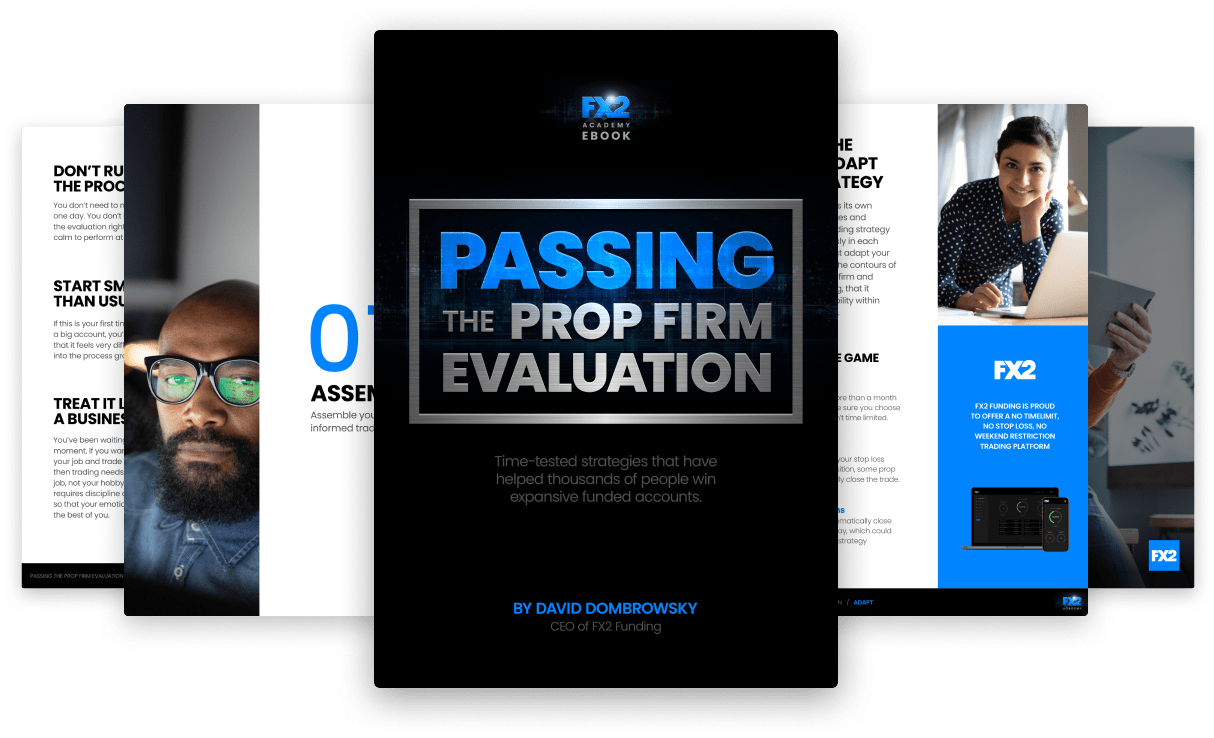
FX2 Funding can help you reach your trading goals. As a prop trading firm, we give you the chance to practice your simple trading strategy with our demo accounts and plenty of available capital to fund your live trades once you are ready to go.
How to Develop a Simple Trading Strategy in 7 Steps

Developing a trading strategy is essential for anyone looking to trade successfully. A well-structured plan helps you navigate the markets with clear rules for when to enter and exit trades, manage risk, and stay disciplined. Below is a step-by-step guide to creating a simple yet effective trading strategy.
1. Pick a Timeframe
Choosing the right time frame is fundamental because it aligns your trading activity with your lifestyle and availability. If you have limited time during the day, more extended time frames, such as daily or weekly charts, suit you better, allowing for less frequent monitoring and trading. Conversely, if you can dedicate several hours daily, shorter timeframes, such as 15-minute or hourly charts, may be more appropriate.
Your timeframe choice also influences the trading style you adopt. Long-term strategies tend to focus on broader market trends and require patience, while short-term strategies demand quick decision-making and constant attention. Selecting a timeframe that fits your schedule and temperament is crucial to maintaining consistency and avoiding burnout.
2. Decide on a Product
The financial markets offer a wide array of trading products, including stocks, forex pairs, commodities, indices, and ETFs. Each product exhibits distinct characteristics in terms of volatility, liquidity, and trading hours. Stocks might be easier to track and understand for beginners, while indices and ETFs provide exposure to broader market movements.
Your product choice should correspond with your timeframe and risk tolerance. For example, volatile assets such as crude oil or specific foreign exchange (forex) pairs are suitable for short-term traders looking to capitalize on price fluctuations. Long-term traders prefer less volatile instruments where daily fluctuations are less critical. Understanding the characteristics of your chosen product helps you tailor your strategy effectively.
3. Identify the Trend
Recognizing the market trend is a key step to improving your trading success. Trading with the trend increases the probability of profitable trades. You can identify trends using technical tools such as moving averages, which smooth out price data to highlight direction over time, or the MACD indicator to gauge momentum.
Alternatively, price action analysis, which looks for patterns of higher highs and higher lows in an uptrend or lower highs and lower lows in a downtrend, can be a straightforward method. Whichever technique you choose, incorporating trend identification into your strategy helps you align trades with the prevailing market direction, reducing the risk of counter-trend losses.
4. Determine Your Risk
Determining how much risk you are willing to take on each trade is crucial to protecting your capital and maintaining emotional control. Even the most experienced traders face unexpected market shocks, so having a clear risk management plan helps mitigate potential losses. This involves setting stop-loss levels and deciding the maximum percentage of your account you are ready to risk per trade.
Your risk tolerance should align with your trading style and the volatility of the assets you trade. For volatile instruments, wider stop-losses might be necessary, but this means you should avoid excessive leverage to prevent large drawdowns. Short-term traders may accept larger position sizes with tight stops, while long-term traders often prefer smaller, more conservative risk exposures that align with broader market moves.
5. Entries
Knowing when to enter a trade is crucial for optimizing your risk-to-reward ratio. For long-term traders, timing entries can improve outcomes by waiting for pullbacks or corrections on lower time frames before committing. For instance, if your primary analysis is on daily charts, checking 4-hour or 1-hour charts for a better entry point can reduce risk and enhance potential gains.
Short-term traders must be even more precise with their entries, as even slight differences in timing can significantly impact profitability. This might involve combining multiple technical signals or waiting for confirmation on faster charts. While some traders use very short timeframes, such as 15 or 30 minutes, others prefer to focus on the best quality setups, even if it means trading less frequently but with higher confidence.
6. Exits
Your exit strategy completes the trading plan by defining when to close a trade. Some traders use fixed profit targets or stop-loss distances based on their risk tolerance, which provides consistency but may not adapt well to changing market conditions. Others prefer trailing stops that move with the price to lock in profits while allowing the trade to run.
There is no one-size-fits-all approach to exits. Short-term traders often set clear targets to maintain a stable risk/reward ratio. Long-term traders might be more flexible, adjusting exits based on market volatility and trend strength. Partial profit-taking is another common tactic, where some of the position is closed at predefined levels to secure gains while letting the rest run.
7. Write Down Your Steps
Documenting your trading plan and daily actions is an excellent habit to build discipline and improve over time. Writing down your strategy, including your entry and exit rules, risk parameters, and the rationale behind each trade, helps you stay focused and consistent.
Additionally, recording the outcome of each trade, whether profitable or not, allows you to analyze patterns and identify weaknesses in your approach. This ongoing review process is key to refining your strategy, avoiding repeated mistakes, and ultimately becoming a more successful trader.
Related Reading
- How to Become an Investor With No Money
- How to Flip Money
- Most Profitable Trading Strategy
- How Much Money Do You Need to Start Trading Stocks
- Is Swing Trading Better Than Day Trading
- Part Time Trading
- How Long Does It Take to Become a Profitable Day Trader
- How to Pick Good Stocks for Short-term
What is a Trading Strategy?

A trading strategy is a well-defined, systematic plan that guides buying and selling decisions in financial markets. It relies on a set of predefined rules and criteria that traders follow to make consistent and objective choices, rather than relying on emotions or guesswork. This structured approach enables traders to identify opportunities, manage risks effectively, and enhance profitability over time.
Trading strategies can range from simple to highly complex. They may incorporate various factors such as investment style (value vs. growth), market capitalization, technical indicators, fundamental analysis, sector focus, diversification, time horizon, risk tolerance, leverage, and tax implications. The essential element is that these strategies are based on objective data and sound analysis, and traders adhere to them diligently. However, a good plan is not static; it requires periodic review and adjustment to stay aligned with evolving market conditions and personal financial goals.
There are many ways to develop a trading strategy. Some traders emphasize technical analysis, utilizing tools such as trend lines, support and resistance levels, candlestick patterns, moving averages, and Fibonacci retracements to identify market trends and signals. Others may focus on fundamental analysis, evaluating economic indicators, company earnings, or geopolitical events. Many successful traders blend both approaches to gain a comprehensive market view. The key is to keep the methodology manageable, as too much information can lead to analysis paralysis, making timely decisions difficult.
Traders often have unique preferences when it comes to their approach, shaped by their individual temperament and comfort zones. Some may thrive with day trading, which involves opening and closing positions within the same trading day to capitalize on short-term market movements. Others prefer strategies such as trading breakouts, buying on dips, or operating within defined price ranges. Ultimately, the most successful approach is one that aligns with the trader’s style and instills confidence in their decision-making process.
In the context of funded trading, firms like FX2 Funding play a significant role in enabling traders to implement their strategies with substantial capital. FX2 Funding offers traders access to funded accounts starting at $200,000, scaling up to $1 million, which allows them to trade without risking their own money. Traders typically retain up to 85% of their profits, which motivates them to develop and adhere to robust trading strategies while managing risk effectively.
At FX2 Funding, we’ve built our proprietary trading firm on the principles of reliability, transparency, and trader success. We stand apart in a crowded industry by delivering what matters most to serious traders: consistently fast payouts, transparent and unchanging rules, and responsive support from experienced trading professionals. Our MT5 platform provides the professional environment traders need to succeed, while our scaling program enables growth from $25,000 to over $400,000 in funding as performance milestones are achieved.
We’ve designed our evaluation process to identify skilled traders and provide them with significant capital without requiring personal financial risk or large upfront investments. Whether you’re an aspiring trader looking to break into the industry or an experienced professional seeking reliable backing, FX2 Funding offers the trustworthy foundation you need to build a successful trading career. Get started with an evaluation account today and discover why thousands of traders worldwide choose FX2 Funding as their prop trading firm partner.
Related Reading
- How Much Do Day Traders Make
- Is Options Trading Worth It
- What is Price Action in Trading
- Is Copy Trading Profitable
- How Much Money Do You Need to Start Day Trading
- Position Trading Strategy
- Short Term Options Trading
- How to Take Profits in Trading
Get Funded and Start Prop Trading Today

Day trading can be profitable, but it isn’t easy. Day trading is not a guaranteed method for making money. Many factors impact profitability, including your experience, strategy, and the market conditions you encounter. The more you learn before you start, the better your chances will be of succeeding.
How Much Money Do Day Traders Make?
It’s challenging to determine precisely how much day traders earn because numerous variables influence their profitability. A day trader’s skill level, strategies, and market conditions all play a role in how much money they can make. Additionally, some day traders report their profits, while others do not. So, any statistics you read are typically based on a small sample of data.
That said, some studies have tried to quantify day trading profits. A 2021 study from the University of California concluded that the top 1% of day traders earned an average annual income of $3.2 million. The top 5% made around $500,000, and the top 10% earned roughly $200,000. However, the study also found that day trading is akin to gambling and that most day traders lose money.
How FX2 Funding Supports Day Trading
At FX2 Funding, we’ve built our proprietary trading firm on the principles of reliability, transparency, and trader success. We stand apart in a crowded industry by delivering what matters most to serious traders: consistently fast payouts, transparent and unchanging rules, and responsive support from experienced trading professionals. Our MT5 platform provides the professional environment traders need to succeed, while our scaling program enables growth from $25,000 to over $400,000 in funding as performance milestones are achieved.
We’ve designed our evaluation process to identify skilled traders and provide them with significant capital without requiring personal financial risk or large upfront investments. Whether you’re an aspiring trader looking to break into the industry or an experienced professional seeking reliable backing, FX2 Funding offers the trustworthy foundation you need to build a successful trading career. Get started with an evaluation account today and discover why thousands of traders worldwide choose FX2 Funding as their prop trading firm partner.
Related Reading
- How Old Do You Have to Be to Start Trading
- What is Orb in Trading
- Best Stocks for Beginners
- Swing Trading Strategies
- Day Trading Indicators
- Trading Risk Management Tools
- Key Levels in Trading
- Best Market to Trade for Beginners